Chain Fee Forecast
Turn partial-day blockchain activity into an inspectable end-of-day gas-fee estimate.
01 — The brief
Start with the useful tension.
Recent-chain intraday activity can be noisy when viewed in isolation. This engine combines sampled current activity, historical fee baselines, a UTC time-of-day profile, and Base-chain pace to produce an inspectable end-of-day fee estimate.
Operators and analysts monitoring Robinhood Chain fee activity who need an intraday EOD estimate with visible data coverage, components, and assumptions.
Independently built the Python CLI, SQLite-backed ingestion and persistence, public-data fetchers, sampled chain activity pipeline, diurnal feature engineering, model training, and EOD forecast inference.
02 — Capability ledger
What exists, what is next.
A plain-language status check, so a polished surface never implies more than the work supports.
Implemented
07- Public daily fee history ingestion
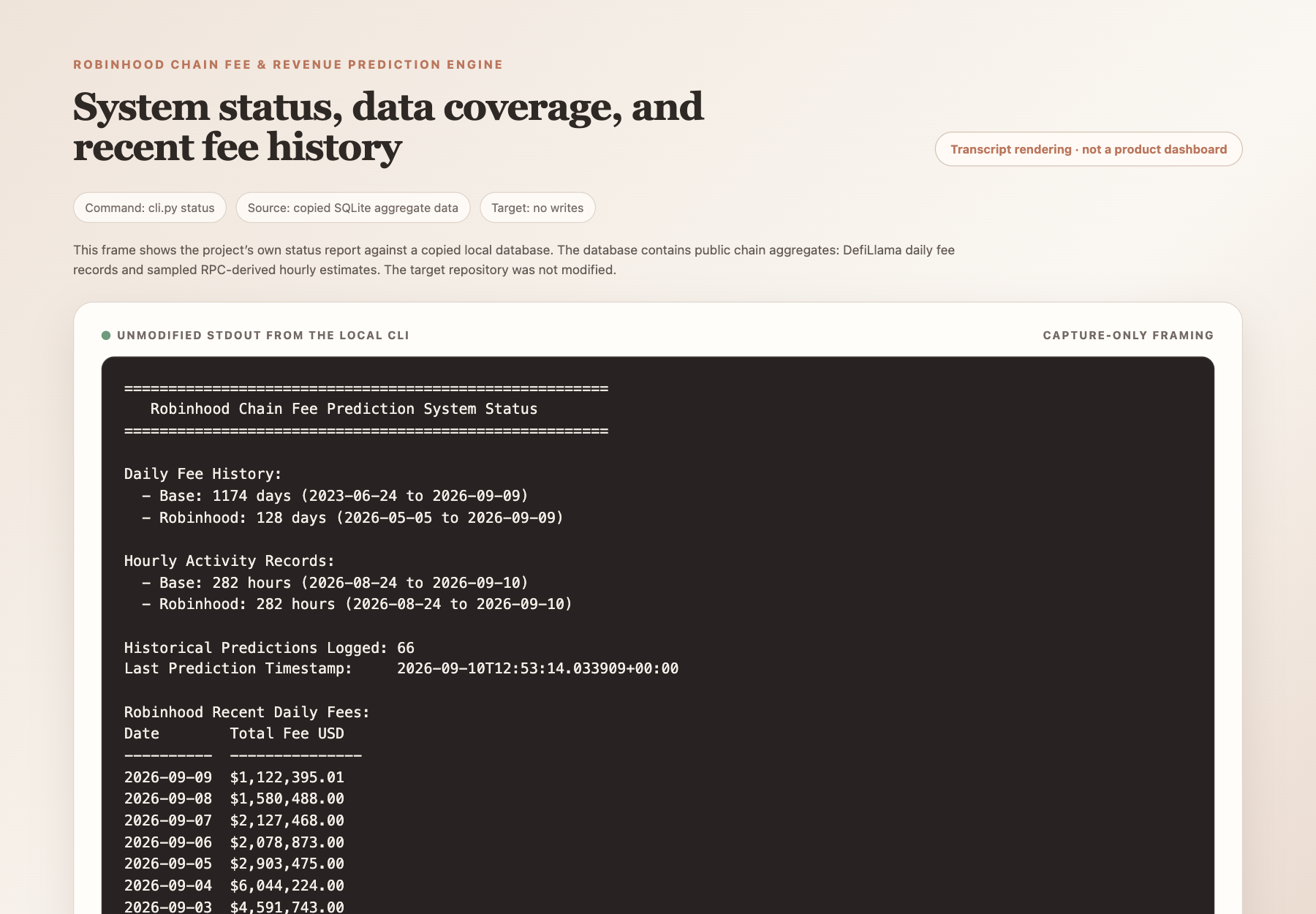
Fetches DefiLlama daily fee charts for Robinhood Chain and Base, converts timestamps to UTC dates, and stores source-labeled daily records in SQLite.
- Sampled hourly chain activity estimates
Locates hourly block windows and extrapolates gas used, base-fee-weighted fee estimates, transaction counts, and ETH/USD values from batched samples on Robinhood Chain and Base.
- SQLite provenance and operational history
Persists daily fees, hourly estimates, diurnal profiles, and prediction logs with source, sampling, timestamp, and estimate fields for later inspection.
- Empirical Robinhood/Base diurnal blending
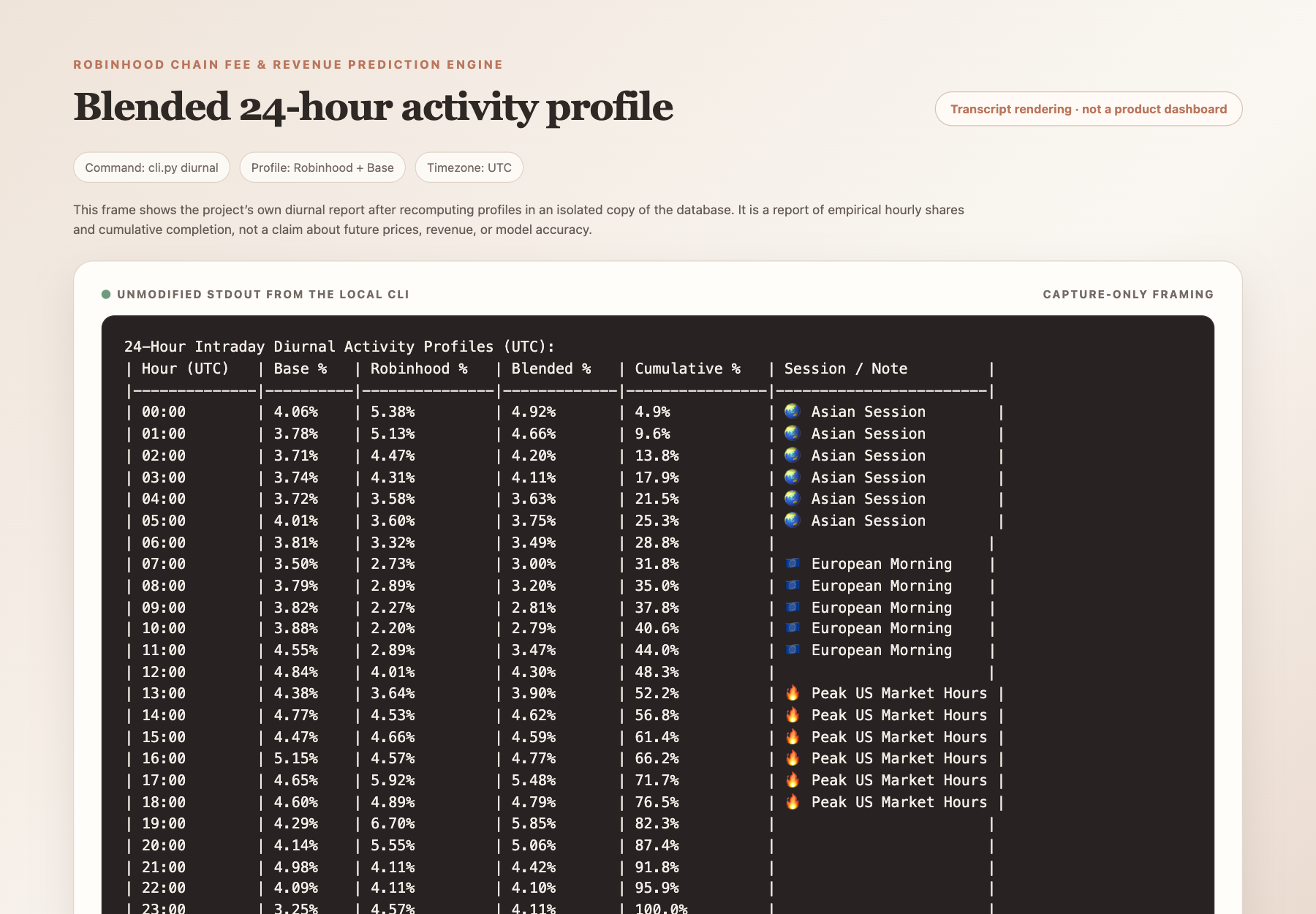
Normalizes complete 24-hour activity days, uses a median profile when at least three full days are available (mean otherwise), falls back to a canonical prior when needed, and blends Robinhood and Base profiles into a cumulative UTC curve.
- Feature vector and bounded EOD ensemble
Builds a 14-value feature vector from accrued fees, cutoff hour, diurnal completion, run-rate, trailing baselines, day-of-week encoding, and Base pace, then blends Ridge inference with a diurnal run-rate projection while enforcing a prediction no lower than fees accrued.
- Code-generated uncertainty bands
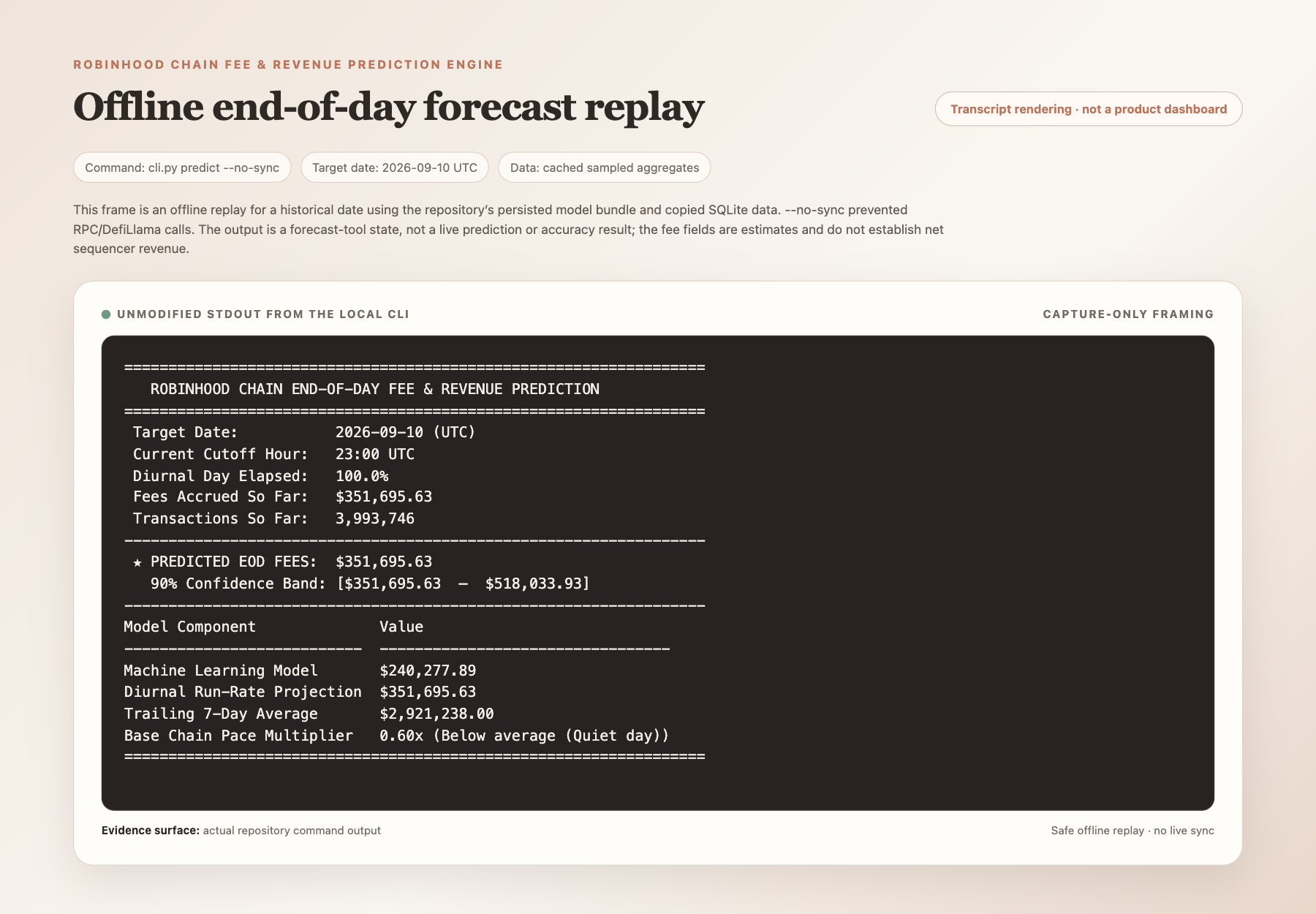
Reports a labeled 90% interval using hourly residual-scale estimates that shrink with remaining diurnal completion; this is an implementation heuristic, not a demonstrated accuracy or coverage result.
- CLI workflow surface
Exposes predict, sync, backfill, train, diurnal, and status commands for inspecting data, updating derived profiles, and producing EOD forecast output.
Planned
00Nothing recorded here yet.
Unverified
02- Net sequencer revenue accounting
The README frames the project around fee revenue net of L1/blob costs, but the inspected implementation calculates sampled gas-fee estimates and leaves revenue_usd nullable; a demonstrated net-revenue calculation was not found.
- Current live-data freshness
The source includes an auto-sync path for current RPC and DefiLlama data, but this extraction intentionally exercised only an offline cached replay; endpoint availability and current-data freshness remain unverified.
03 — Design decisions
The reasoning stays in the room.
01Blend chain-specific activity with a Base prior
The source treats Robinhood Chain as young and uses the deeper Base-chain intraday shape to regularize the Robinhood profile rather than relying on one noisy chain in isolation.
02Normalize complete days before aggregating hourly shape
Per-day normalization removes day-to-day magnitude bias and lets the diurnal profile represent shape; a median is used when enough complete days exist to reduce the influence of single-hour spikes.
03Estimate hourly activity from sparse, rate-limited block samples
Timestamp interpolation plus chunked, throttled JSON-RPC sampling provides hourly estimates without fetching every block in the window.
04Use a bounded ensemble for intraday inference
The predictor shifts weight toward observed diurnal run-rate as the day progresses, moderates remaining pace using Base activity, and never returns an EOD estimate below fees already accrued.
05Use recency-weighted positive Ridge regression
The training code applies an approximately 21-day recency half-life, a positive-coefficient Ridge model, and alpha=20.0 to reduce obsolete-regime influence and overfitting risk.
06Keep source labels and estimate fields in the data model
The schema preserves whether daily data came from DefiLlama or a completed hourly sync and distinguishes estimated gas, fee, transaction, price, and sampling values for inspection.
04 — In the hand
Screens that explain themselves.
Images are shown as captured when available. Missing captures are labelled rather than quietly invented.
05 — A short walk-through
See the shape of the interaction.
CLI coverage to offline EOD forecast
- 0-5s — Start in an isolated copy of the repository with live integrations disabled and run cli.py status; frame the record counts and date ranges so the cache boundary is visible.
- 5-14s — Run cli.py diurnal in the same isolated copy; scroll or hold on the 24-hour UTC table to show Base, Robinhood, blended, and cumulative shares.
- 14-27s — Run cli.py predict --no-sync --date 2026-09-10 using the cached sampled aggregates; hold on accrued fees, the EOD estimate, 90% band, trailing baseline, and Base pace component.
- 27-30s — Stop on the forecast output and show a caption that the values are offline fee estimates from cached public aggregates, not live net sequencer revenue or an accuracy result.
The materials