Base Launch Observer
Inspect a token launch through pool activity, historical evidence, and explicit trading-safety boundaries.
01 — The brief
Start with the useful tension.
Launch liquidity and indexed market activity change quickly. A trade-oriented monitor needs durable, block-aware evidence and a clear boundary between observation, dry-run checks, and live transaction paths.
Developers and researchers evaluating token launches on Base who need pool-level market context without initiating trades.
Independently built the Base launch observation and trading-research implementation: durable market and history collection, a local dashboard, and fail-closed Uniswap v3/v4 evaluation paths.
02 — Capability ledger
What exists, what is next.
A plain-language status check, so a polished surface never implies more than the work supports.
Implemented
05- Persisted market snapshots
Samples eligible direct token/Base USDC, WETH, and ETH pools and stores price, reported liquidity, rolling 24h volume, indexed five-minute buy/sell counts, token metadata, primary-pool state, pinned RPC calls, and explicit errors in JSONL records.
- Historical event backfill
Backfills Base launch-window logs, transactions, receipts, blocks, transfers, swaps, venue discovery, reference evidence, and retained gaps/errors while tracking coverage in a separate status document.
- Local dashboard with SSE updates
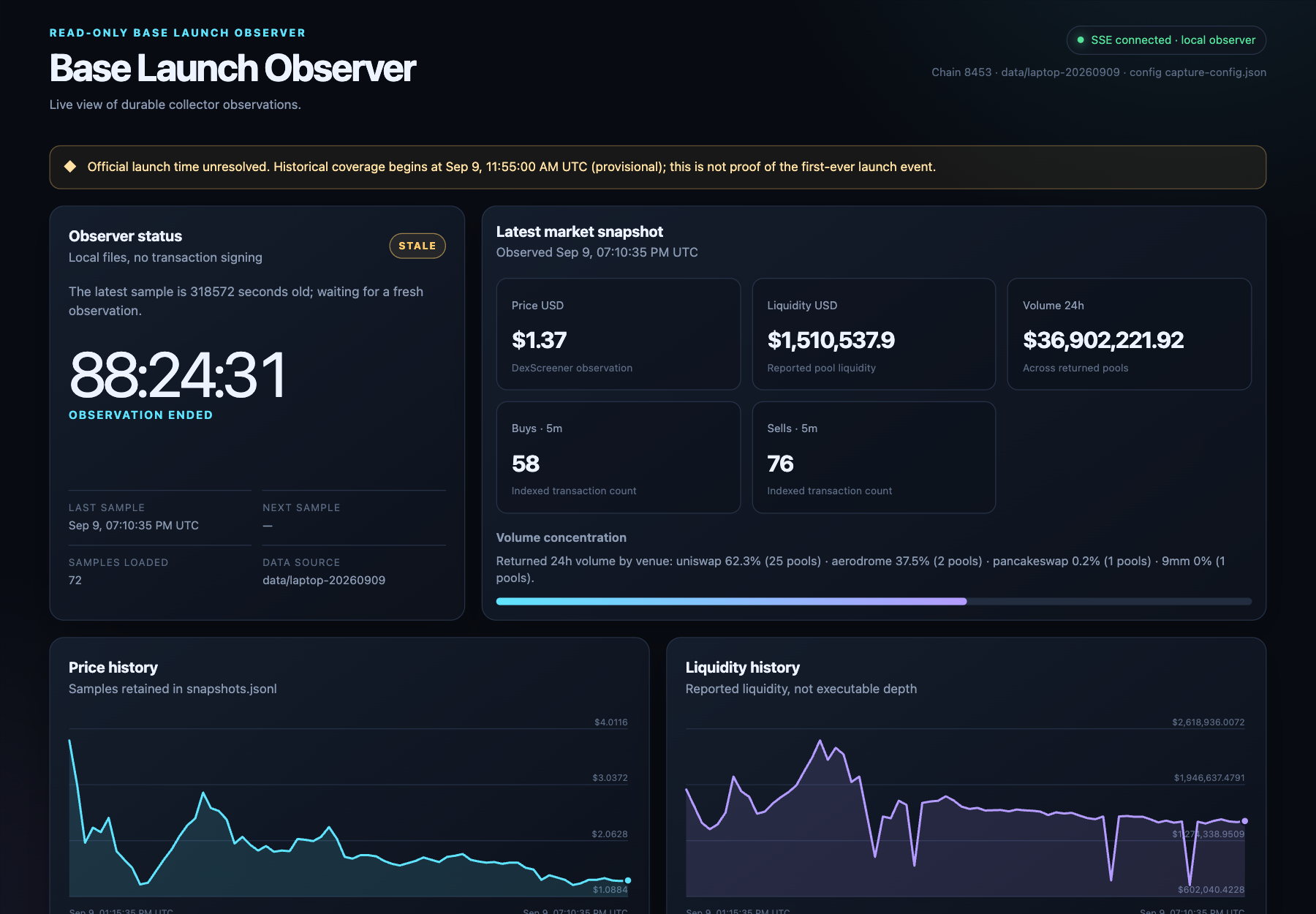
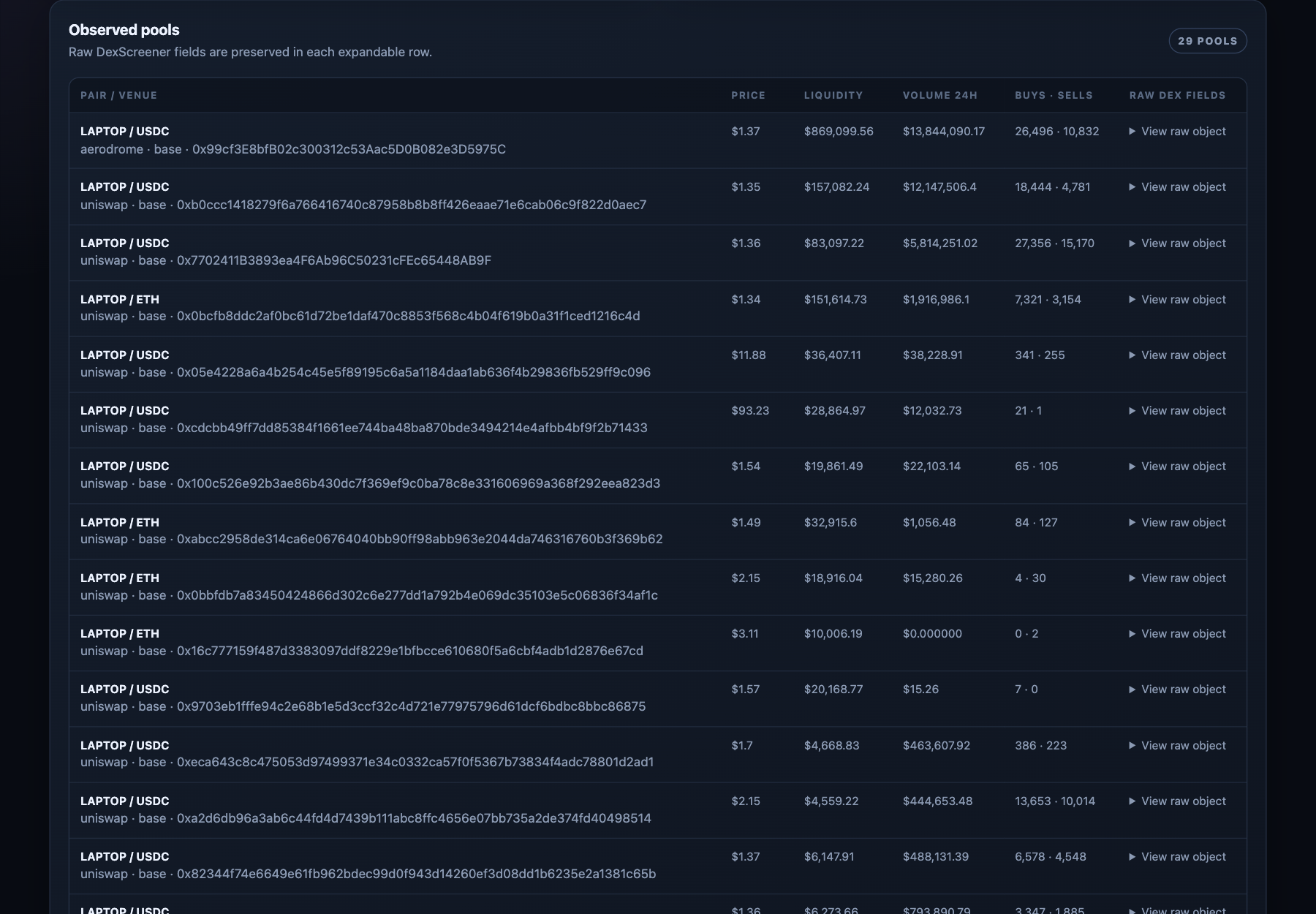
Serves a local-only HTML dashboard from persisted files and refreshes state over Server-Sent Events with polling fallback; the UI renders status, market metrics, SVG price/liquidity charts, observed pools with expandable raw fields, automated commentary, optional reference-wallet context, and caveats.
- Uniswap v3/v4 candidate detection
Read-only detector modules parse Uniswap v3 PoolCreated and v4 Initialize events, filter candidates to exactly one configured quote currency, retain block/transaction/log identity, and compute v4 PoolIds; the implementation remains partial around lifecycle recovery and v4 quoting.
- Fail-closed dry-run evaluation
The configured dry-run path checks token identity, pool liquidity/reserves, an exact v3 quote, price impact, optional valuation, quote-based round-trip heuristics, an exact-buy eth_call, and a fee budget before reporting a no-broadcast dry-run result. V4 candidates stop with an explicit disabled reason until exact quoting and route simulation exist.
Planned
01- Live execution activation
Planned only: the repository contains v3/v4 calldata builders plus fee, nonce, signing, and broadcast modules, but live v3 remains disabled because round-trip checks do not transfer tokens and live v4 lacks an exact quote and verified route simulation. Receipt durability and restart recovery are also unfinished.
Unverified
00Nothing recorded here yet.
03 — Design decisions
The reasoning stays in the room.
01Separate observation from execution
The observer is intentionally a local read-only surface: it reads persisted files, exposes GET/HEAD plus SSE routes, and states that it never signs, broadcasts, or requests private keys. This makes the capture and research workflow inspectable without starting the trading entrypoint.
02Preserve raw evidence and uncertainty
Snapshots retain raw indexer fields and pinned RPC results, while history status retains explicit errors and gaps. The unresolved official launch timestamp is surfaced as provisional instead of being presented as fact.
03Fail closed while execution checks are incomplete
Missing or unsafe identity, liquidity, quote, impact, simulation, fee, or route checks return no-transaction results. The documented safety posture keeps both protocol live paths disabled instead of weakening a failed check.
04Treat pool-specific liquidity as different from executable depth
V4 state reads use ReservesLens and set reserves to zero when lens data fails rather than using PoolManager's shared balance. The dashboard labels reported liquidity as non-executable depth and repeats the limitation in its caveats.
05Pin and deduplicate candidate evidence
Candidate records retain block, transaction, and log ordering metadata; a persisted cursor and an in-process key based on block hash, transaction hash, and log index prevent repeated evaluation across scanned ranges.
04 — In the hand
Screens that explain themselves.
Images are shown as captured when available. Missing captures are labelled rather than quietly invented.
05 — A short walk-through
See the shape of the interaction.
Base Launch Observer: inspect a persisted launch window
- 0–4s: Open http://127.0.0.1:4420/ and show the SSE-connected local dashboard, read-only status, and provisional launch-time notice.
- 4–12s: Hold on the latest snapshot metrics and price/liquidity charts, then scroll to the Observed pools table.
- 12–20s: Expand one View raw object disclosure to show preserved source fields; keep the interaction read-only.
- 20–30s: Frame only Historical coverage, Automated commentary, and Read the numbers carefully; exclude reference-wallet context and stop with the no-signing/no-broadcast caveat visible.
The materials